Teaching young children football isn’t simply a matter of showing them a skill and then putting them into a game.
At ICFA, we teach skills through a process that gives children time to understand what they’re learning, repeat it, develop it and then recognise where it belongs in football.
Both Coach Morgan Beaumont and Coach Antonio Castro hold degrees in Sport Science (Manchester and University of Amsterdam respectively). The programme we deliver at ICFA has developed from the body of knowledge Coach Morgan has built over many years, through both his academic training and his football playing and coaching career augmented by Coach Antonio’s input. It has continued to develop through practical experience of teaching children of different ages and abilities, rather than being based on any single coaching method.
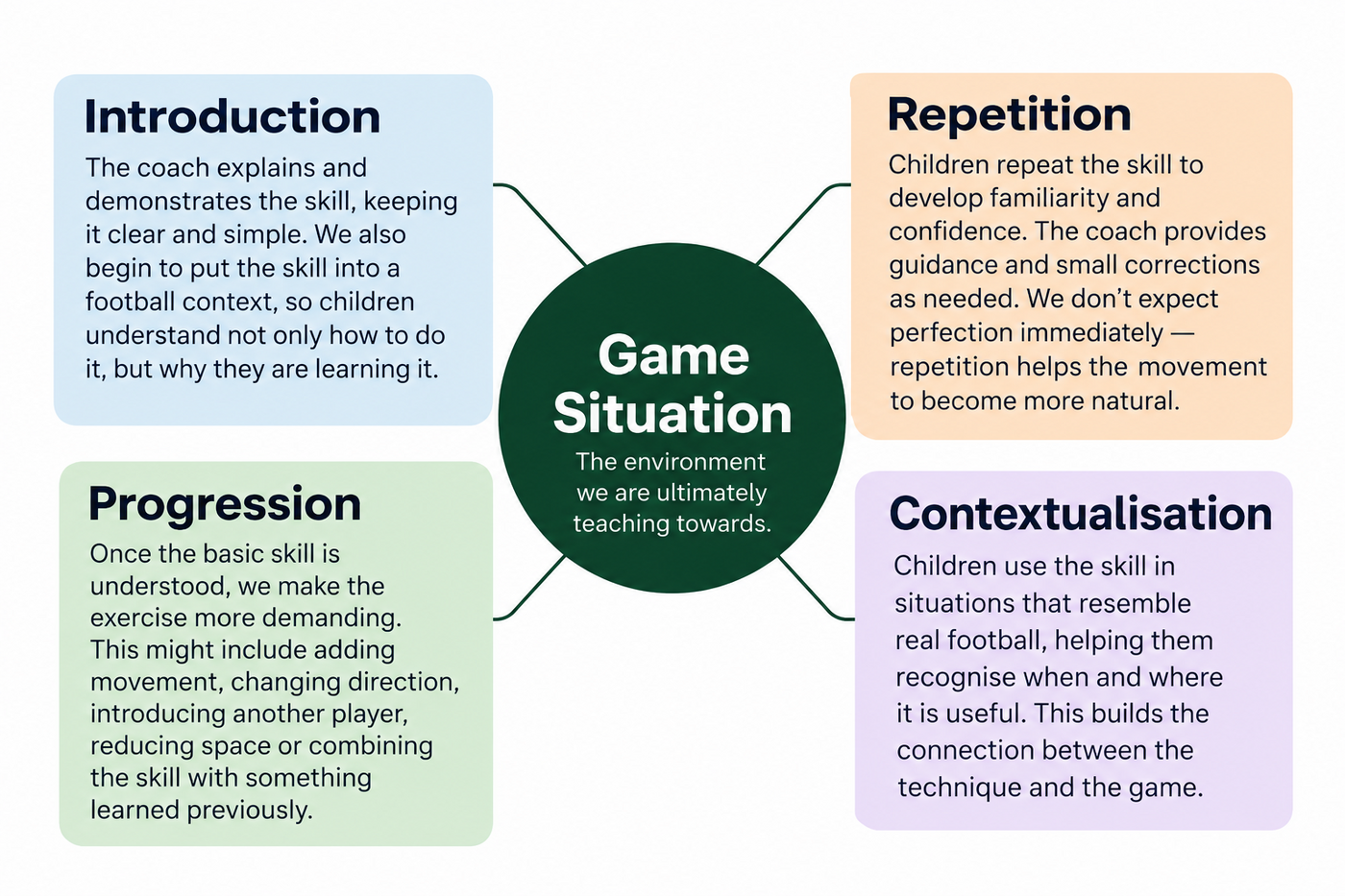
The basic learning process we use is:
Introduction → Repetition → Progression → Contextualisation with the Game Situation at the centre of what we are ultimately teaching towards.
The first four are learning stages. The game situation isn’t just another stage in the sequence. It is the principal environment in which we eventually want the child to be able to use what they have learned.
Introduction
The first stage is introducing the skill.
The coach explains what the children are going to learn and demonstrates it clearly. With younger children especially, the explanation needs to be short and easy to follow.
At this point we also begin putting the skill into a football context.
If we’re teaching a turn, for example, we don’t simply demonstrate the movement. We explain the different situations in which a player might use it: to move away from an opponent, change direction, protect the ball or find space.
If we’re teaching a particular type of pass, we explain when that pass might be useful and what the player is trying to achieve.
So although contextualisation appears later as a formal stage in the learning process, it is already happening during the introduction.
Children need to understand not only how to do something, but why they are learning it.
Repetition
Once the skill has been introduced, children need the opportunity to repeat it.
A child might understand what the coach has demonstrated without yet being able to make their body do it consistently.
This needs practice.
During this stage, children repeat the movement enough times for it to become more familiar. The coach can make small corrections, demonstrate again where necessary and help children who are finding a particular part difficult.
We don’t expect a skill to look perfect immediately.
The purpose of repetition is to give the child enough experience of the movement for it to begin to feel natural.
Progression
Once children begin to understand the basic skill, we make the exercise more demanding.
This progression can happen in many ways.
We might add movement, change direction, increase the distance, introduce another player, reduce the available space or combine the skill with something learned previously.
The important point is that the next step grows out of what the child has already learned.
We don’t make an exercise more complicated simply for the sake of making it harder.
The progression should ask a little more of the player while still allowing them to use the skill successfully.
Contextualisation
The next stage is to place the skill more clearly into football.
This is where children begin using what they have practised in situations that resemble something they might actually encounter when playing.
If we’ve been working on turning, there might now be an opponent or a direction the player needs to escape into.
If we’ve been working on passing, the player may have to decide where the pass should go rather than simply passing to a predetermined place.
The purpose is to help the child recognise when and where the skill is useful.
Being able to perform a technique on its own doesn’t necessarily mean a player will recognise when to use it during football.
That connection has to be taught as well.
Context starts from the beginning
Although contextualisation is one of the later stages in the learning process, one of the differences in our program is that contextualisation is present from the start even in the youngest age groups.
From the first demonstration, our coaches explain the situations in which a skill can be used.
We may show several examples.
A turn might be used when an opponent is behind you, beside you or approaching from the front. A pass might be used to keep possession, move the ball away from pressure or play a teammate into space.
That discussion continues while the children practise.
Then, when we reach the formal contextualisation stage shown later in the infogram, they aren’t seeing the football situation for the first time. They already have some idea of what they’re looking for.
The exercise gives them the opportunity to recognise and use it themselves.
Guided response learning
Alongside this teaching process, we also use a guided response approach.
We don’t want children simply to copy instructions without understanding what they are doing. But equally, we don’t expect young players to discover everything for themselves.
The coach gives enough information to point the child in the right direction, then asks questions, offers choices and gives prompts that help the player work out the answer.
For example, rather than always saying, “Pass the ball there,” a coach might ask, “Where is the space?” or “Which player gives you the safest option?”
If a player is under pressure, the coach might ask what they could do to protect the ball or how they could create more room.
The aim is to make the child think about the situation rather than simply follow an instruction.
This matters because football is constantly changing environment (much like life).
A player can’t rely on being told exactly what to do in every situation. They need to learn to look, recognise what is happening and choose an appropriate response.
At the same time, we don’t believe young children should simply be left to work everything out without guidance.
If a child doesn’t yet know what the possible solutions are, asking them to discover the answer by themselves can simply leave them confused, which is why the response is guided and the amount of guidance is changed according to the situation and the age and experience of the player.
For example, the coach may demonstrate a technique, explain several ways it can be used and then ask the child to recognise which option fits the situation in front of them.
As children become more experienced, the amount of guidance can gradually reduce. The coach can ask more questions and give fewer direct answers because the player now has a larger set of skills and experiences to draw on.
Other ways of teaching football
There are several established ways of teaching football skills, and each has something useful to offer.
A traditional technique-first approach usually teaches a skill in isolation, repeats it through drills and then introduces it into a game. This can be useful for learning the mechanics of a movement, but on its own it can leave players unsure about when or why to use the skill.
Teaching Games for Understanding takes almost the opposite approach. Players begin with a game or game problem and are encouraged to work out what skills and decisions are needed to solve it. This is useful for developing tactical understanding and decision-making.
A constraints-led approach changes the conditions around the player — such as the size of the space, number of players, rules or available time — so that different solutions emerge naturally from the activity.
Guided discovery uses questions and prompts rather than simply giving players every answer. The coach guides the player towards recognising possible solutions and making decisions for themselves.
At ICFA, we don’t use any one of these approaches exclusively.
Especially with younger or inexperienced players, we believe there is value in explicitly teaching technique and giving children enough repetition to become comfortable with it. At the same time, we want them to understand why the skill matters, recognise when it can be used and gradually make more of those decisions themselves.
Our model therefore combines direct teaching, repetition, progression, contextual learning and guided response, with the game situation remaining central to the whole process.
The game stays at the centre
The game situation sits at the centre of the way we teach.
Everything we introduce has a purpose within football. Repetition gives children enough experience of a skill to use it more reliably. Progression asks them to perform it under increasingly demanding conditions. Contextualisation helps them understand when and why they might choose to use it.
All four lead back to the same question: can the child use what they’ve learned when they are actually playing football?
This doesn’t mean every lesson ends with a match.
It means the game is the reason for what we are teaching - we are there for football after all.
Why we teach through the ball
The same principle influences the equipment we use.
At ICFA, the ball is our teaching tool. We use cones and markers to organise space and create exercises, but we don’t generally build lessons around props when the same learning can take place with a football.
This is also consistent with FA guidance for younger players, which encourages coaches to give children lots of contact with the ball and to use the ball as much as possible during training.
Children’s football sessions can sometimes include ladders, hoops and other equipment designed to develop movement or coordination. Those activities can have a place, but our preference is to develop as much of that learning as possible through interaction with the ball itself.
The ball gives the player constant feedback. A touch that is too heavy, a change of direction that is poorly controlled or a pass that is badly weighted produces an immediate result. The child has to adjust their balance, movement, timing and coordination in response.
This becomes increasingly important as players develop. Research into youth football training also supports giving players frequent involvement with the ball while gradually placing those skills into situations that include opponents, space and decisions.
For younger players especially, lesson time is limited, so we want as much of that time as possible to contribute directly to their familiarity and confidence with the ball.
We do use equipment where it has a clear purpose — to define an area, provide a target or alter the conditions of an exercise. But the equipment supports the teaching rather than becoming the activity itself.
If the eventual aim is for the child to play football, we think it makes sense for the football to be present in as much of the learning as possible.
A process that works across the whole programme
It’s important to distinguish between the way we teach an individual skill and the structure of a single ICFA lesson.
Our programme runs across approximately 30 lessons during the year.
Over that time, children are introduced to new skills, repeat skills they already know and gradually work with them in more demanding and more recognisable football situations.
A skill may be introduced in one class and revisited many times afterwards.
Something introduced earlier in the year may now be at the repetition or progression stage, while another skill is being taught for the first time.
The process therefore takes place both within individual exercises and across the programme as a whole.
What happens within one lesson
Our classes also differ according to the age of the children.
Sessions range from 45 minutes for our youngest players through 60 and 75 minutes to 90 minutes for the older groups.
Within that time, a coach may be working at several different points in the learning process.
One activity may introduce something new. Another may repeat or develop a skill the children have worked on before. Later activities may ask them to recognise where those skills belong in football.
The structure is therefore not a rigid formula in which every lesson begins with Introduction and ends with a match.
The learning process is cumulative.
The youngest players
This is particularly clear with our youngest players. They don’t yet spend part of their session playing a football match.
Much of their work is one-to-one: one player with a ball, and then gradually simple interactions with another player.
At that age we are teaching the foundations they will eventually need in a game: controlling the ball, changing direction, moving with it, responding to another player and beginning to understand space.
So when we put the Game Situation at the centre of our teaching model, we don’t mean that every child must be playing a match in every lesson.
It means that the reason we teach a technique is ultimately so that the child can use it when playing football.
For the youngest player, that game environment may still be some distance away. For an older player, it may appear during the same session.
In both cases, the direction of the teaching is the same.
Not every child moves through the process at the same speed
Children don’t all learn at the same rate. Some understand a movement immediately. Others need more demonstrations or more repetition.
That doesn’t mean one child is capable and another isn’t.
It simply means the coach may need to spend more time at one stage or adjust an exercise so that the child can succeed before moving on.
The same is true within a class. One player might be ready for a more demanding version of an exercise while another still needs a little more repetition.
Good coaching means recognising that difference rather than expecting every child to progress at exactly the same speed.
Why we teach this way
Ultimately, we want children to be able to use what they learn.
There is little value in a child being able to perform a technique perfectly in an exercise if they don’t recognise when to use it during football. At the same time, simply putting children into games and hoping they work everything out for themselves can leave gaps in their technique.
Our approach sits between those two extremes.
We teach the skill clearly, give children enough time to practise it, make it progressively more demanding and help them understand where it belongs in football.
At the same time, we gradually move from giving the answer towards helping the child find the answer.
The aim isn’t simply to teach a collection of football techniques.
It is to help children understand what they can do with those techniques, when they might use them and how to make those decisions for themselves when the game changes around them. Football is life after all and these decision making abilities will influence the way children can adapt and change under pressure later in life also.
Further reading
For parents or coaches interested in the ideas behind this approach, The FA has useful material on ball mastery for 5–11-year-olds, guided discovery, the constraints-led approach and the relationship between practice design and decision-making. There is also a growing body of research into skill acquisition in youth football, including work on small-sided games, representative practice and the importance of giving players repeated opportunities to interact with the ball while still learning to recognise opponents, space and choices. These approaches differ in emphasis, but they share a common concern: helping players transfer what they practise into what they actually do when they play football.