
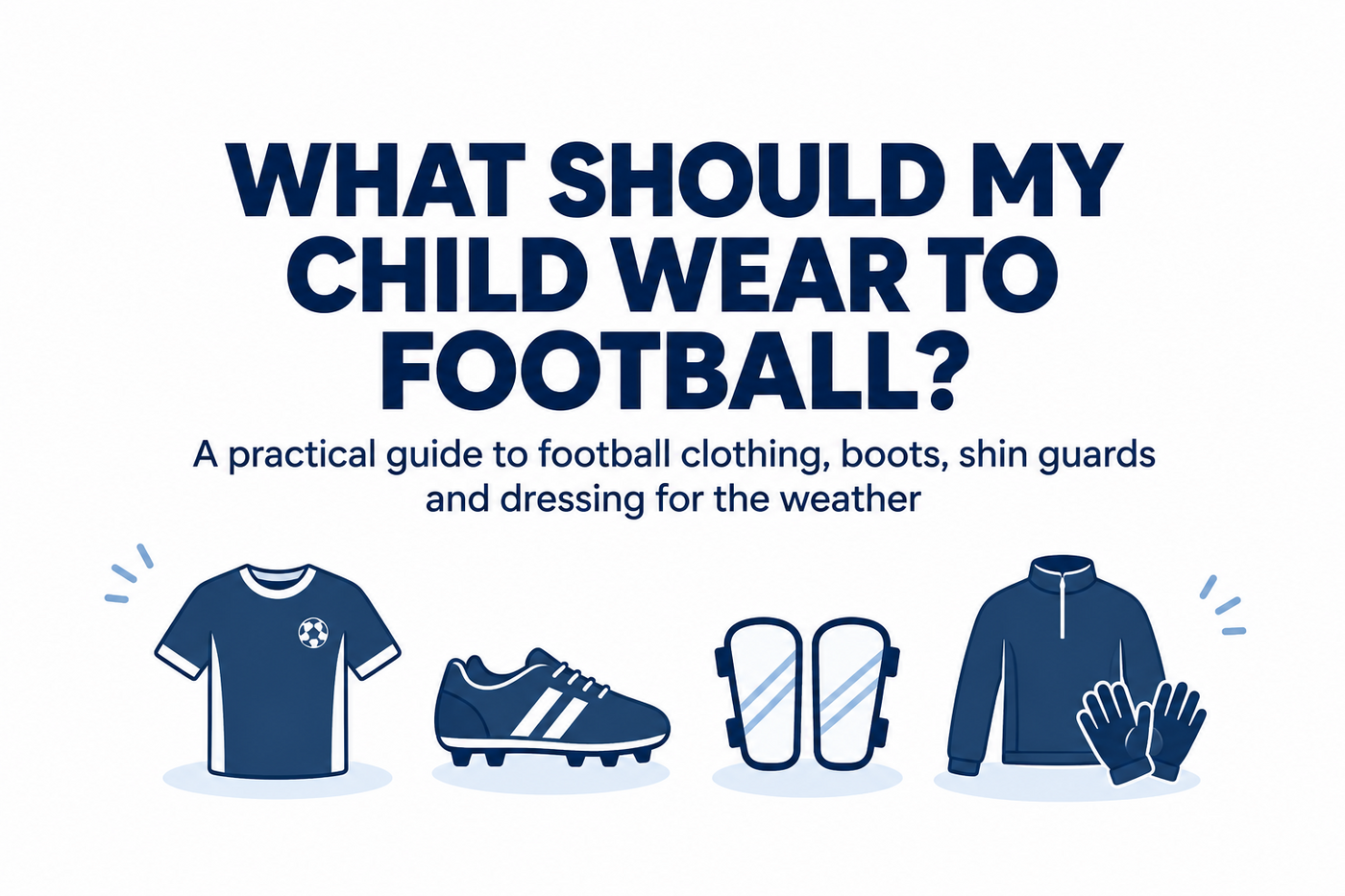
Parents ask us this question most often, especially if parents are unfamiliar with the weather in The Netherlands or with the sport.
What should my child wear? Do they need football boots? Do they need shin guards? What happens when it’s cold? Do they need a compulsory football kit?
The short answer is that children need to be comfortable, able to move freely and be dressed appropriately for the weather.
We don’t currently have a compulsory ICFA uniform
At the moment, our players do not need to wear an ICFA uniform.
We like the fact that they can arrive in the football shirt, tracksuit or sports clothes they already enjoy wearing because we feel like this allows them to express their identity. And also lets them wear some of the kits that they get for Christmas from grandparents and parents. :)
Supporting their favourite team or player can be part of the excitement of coming to football for younger players and going to choose a favourite kit to emulate their favourite player can be part of the preparation for their first lesson. Many clubs also allow printing of a child’s name on the back of a team kit and this is really fun for younger players (and solves gift giving dilemmas).
The important thing for us is not what colour the shirt is or which team is printed on it. It is whether the player can move properly in what they are wearing.
That doesn’t mean we would never introduce optional ICFA clothing in the future, but there is currently no requirement to buy a particular kit in order to take part. We’re also aware that having mandatory kit makes yet another ‘list item’ for parents to have to prepare for before football class and we don’t want to stress parents out even further or make them buy duplicates of items they may already have.
So what does work for normal football sessions?
In mild weather, a T-shirt or football shirt with shorts is usually enough.
As the weather gets cooler, tracksuit bottoms, a sweatshirt or training top can be added with appropriate under layers.
The main thing is to avoid clothing that is too restrictive, too heavy or likely to make movement difficult.
Football involves running, turning, kicking, stopping and changing direction constantly. Children need clothes that allow them to do that comfortably.
Football boots and trainers
For our youngest players or players who are attending their first trial lesson ordinary athletic trainers are fine. Once they have had their trial they can graduate to proper football footwear.
For proper footwear we recommend football boots (cleats, for our American families) with short moulded rubber studs. These provide suitable grip for the surface while still allowing children to run, turn and change direction comfortably.
Long studs, metal studs and screw-in studs are not suitable for our sessions.
If you are buying football boots specifically for ICFA and are unsure which type to choose, look for boots with short, fixed rubber studs rather than traditional long-studded grass boots.
About the shin guards
Shin guards are required from the first lesson for all players except Minis. They are required because if there is a player interception during a game resulting in a knock to the shin it can be extremely painful for the player and can ultimately lead to an uncomfortable and unwanted injury.
Shin guards should fit comfortably under long football socks and should not be so large or bulky that they interfere with movement.
For Minis, the focus is initially on becoming comfortable moving with the ball and we don’t engage in games at this age, so shin guards are not required.
In Junior Academy and above players who arrive without shin guards will not be able to take part in the game section of the class and may, depending on the circumstances, be asked to sit out or be sent home.
This is a non-negotiable safety requirement.
Dressing for cold weather
‘There is no such thing as bad weather, only bad clothing choices.’
Dressing for cold, damp weather is probably where most of the confusion happens. Amsterdam football weather can be cold, wet and windy, but children also heat up very quickly once they start running.
That means the best solution is usually layers, rather than one very heavy item of clothing. A thermal or lightweight base layer underneath a football shirt is optimal. Think of the thermals that you would use to ski, for example.
Many thermals are marked for the temperature so you can rate them on the expected outdoor temperature and base your decision on whether a child needs more layers on the weight of the thermal under layer. Tracksuit bottoms, a training top, thin wind-resistant gloves and a hat work well in combination with thermals. Often we find that if a child has adequate thermal under layers they won’t need too many outer layers.
Cotton clothing is not recommended in cold weather. Be sure to purchase either technical fabrics or wool.
A word of warning on the winter coat
A very bulky winter coat may keep a child warm while they are standing still, but is extremely impractical once they start running and playing football. For this reason we ask that parents remove their child’s outer coat and preferably keep it with them in a plastic bag or waterproof dry bag if it is raining or put it on the side of the field.
It doesn’t have to be below freezing to feel very cold
One thing worth remembering in the Netherlands is that the temperature on the weather app does not always tell you how cold it is going to feel on the pitch even if it shows a perceived or windchill temperature. A morning that is technically 5°C or 6°C can feel considerably colder when there is strong wind, damp air or rain. There is also cold air rising from the ground which complicates the perception of the temperate.
Wet clothing also removes heat much more quickly, so a child who becomes damp and then spends time standing still can cool down surprisingly fast.
Children can also lose body heat more quickly than adults, so it is worth being a little more cautious about keeping them warm than you might be for yourself. This is where layers, gloves and something that keeps the wind and rain off can make a real difference.
It is also useful to have a dry extra layer available in a waterproof bag, plastic bag or dry bag for afterwards, particularly on wet days.
What about rain?
‘We are not made of sugar.’
Football is an outdoor sport, so a bit of rain is fairly normal and our football is never cancelled for rain, even if it seems like it is a downpour. While it may be uncomfortable for spectators it’s not going to affect training.
A lightweight waterproof training jacket can be useful, particularly before a session starts or in steady rain.
Again, something light and easy to move in is usually better than a thick coat. If there is an official red weather warning published by the Dutch KNMI we will make decisions about whether a session can safely go ahead, but if we were going to cancel training every time it rained we would never be able to hold any sessions, so we always train, even in the rain. Just make sure there are adequate dry clothes to change into, and enough layers to keep warm.
A few small things to note
A water bottle is mandatory, even in cold weather.
Jewellery should be removed before playing, and anything loose or likely to catch during movement is best avoided.
Long hair should be tied back if it gets in the child’s way.
And if the weather is cold, it is often worth bringing one extra layer rather than discovering halfway through the morning that your child is freezing.
For a quick reference, you can also use our:
General Football Clothing Guide
Cold Weather Football Clothing Guide
These give a simple overview of what works well throughout the year including embedded links to products available from Decathlon.